On this page
A Taekwondo class runs on a small set of spoken commands, called guryeong (구령) in Korean. They are short, they are said sharply, and the whole class responds at once. Knowing what each one means helps new students keep up and helps parents understand what is happening through the lobby window.
The opening and closing routine
Almost every class starts and ends with the same three commands.
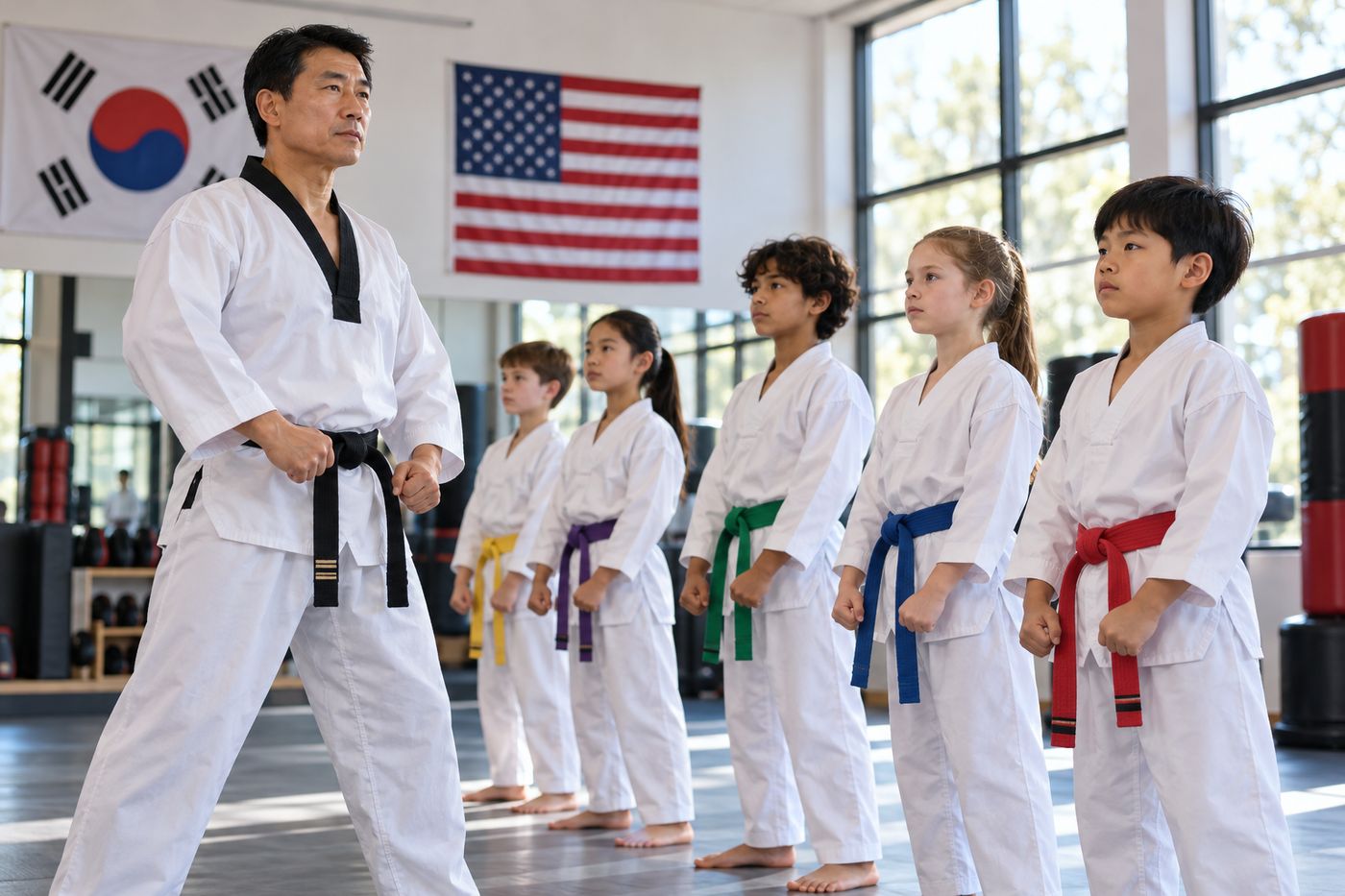
Charyeot (차렷), attention. Students bring their heels together, stand straight with fists lightly closed at their sides, and look ahead. In many schools the senior student calls this to bring the room to order before the instructor speaks.
Gyeongnye (경례), bow. Students bow from the waist, about 30 degrees, keeping their eyes slightly down, then come back up to attention. The instructor bows in return. You may hear it spelled kyungye or kyung-ye on posters; it is the same word.
Junbi (준비), ready. Students step their left foot out to shoulder width into the parallel stance and bring their fists in front of the belt, elbows slightly bent. This is the ready position, gibon junbi, and nearly every form and drill begins from it.
At the end of class, the order repeats: attention, bow to the instructor, sometimes a bow to the flags, and often a group gamsahamnida (thank you).
Commands during drills
Sijak (시작), begin. Starts a form, a drill or a sparring round.
Geuman (그만), stop. Everyone freezes. In sparring this is the referee’s command to stop fighting, and it must be obeyed instantly.
Baro (바로), return. Students return to the ready stance, usually at the end of a form or between repetitions. Literally it means “straight” or “right away.”
Swieo (쉬어), at ease. Students relax, usually with feet apart and hands behind the back. Some schools use it before the instructor explains a technique.
Dwiro dora (뒤로 돌아), about face. Students turn 180 degrees to face the back of the room, often used in line drills.
Anja (앉아), sit, and ireoseo (일어서), stand up. Used when the class sits for an explanation or a meditation at the end of class.
The gihap
Gihap (기합), usually spelled kihap, is the short shout that goes with a strike or the key moves of a form. Gi is energy and hap means to gather, so the idea is to focus your breath and power into one moment. There’s no fixed word to shout. Most students use a sharp “hap!”, “ya!” or “hya!” from the stomach rather than the throat. Examiners at belt tests listen for strong gihaps, because they show confidence and focus.
Sparring commands
In sparring and competition, the referee uses a few more commands. Cheong (청) and hong (홍) call the blue and red fighters to their marks. Gallyeo (갈려) separates fighters who are clinched, and gyesok (계속) tells them to continue. Sijak and geuman start and stop each round. Our sparring guide covers the scoring.
How to respond
In most schools, students answer a command by doing it, not by speaking. When the instructor speaks directly to a student, though, a clear “Yes, sir,” “Yes, ma’am” or “Yes, sabeomnim” is expected. Some schools have students reply to commands with a loud ne! (네, yes). If you are new, follow the senior students in the front row. They set the timing, and copying them is exactly what everyone else did on their first day.
Our full Korean terms glossary has every command with audio, so you can hear how they sound before your next class.
Questions parents and students ask
What does 'charyeot' mean in Taekwondo?
Charyeot (차렷) means attention. Students stand straight with heels together and fists at their sides, looking forward.
Is it kyungye or gyeongnye?
Both spell the same Korean word, 경례, meaning bow. 'Kyungye' and 'kyung-ye' are older or informal spellings; 'gyeongnye' follows official romanization. It sounds roughly like 'kyung-nyeh.'
What do you shout in Taekwondo?
The shout is called gihap (기합, often spelled kihap). It is not a particular word: most students shout a short, sharp sound from the stomach such as 'hap!' or 'ya!'