On this page
The hook kick, huryeo chagi (후려차기), is the roundhouse kick’s mirror image. Instead of swinging into the target from the outside, the leg extends just past the target and then whips back, catching it with the heel or sole. It is mostly a head kick, it comes from an angle opponents do not expect, and it is the base of the spinning hook kick, one of the signature moves of advanced Taekwondo.
What the hook kick is used for
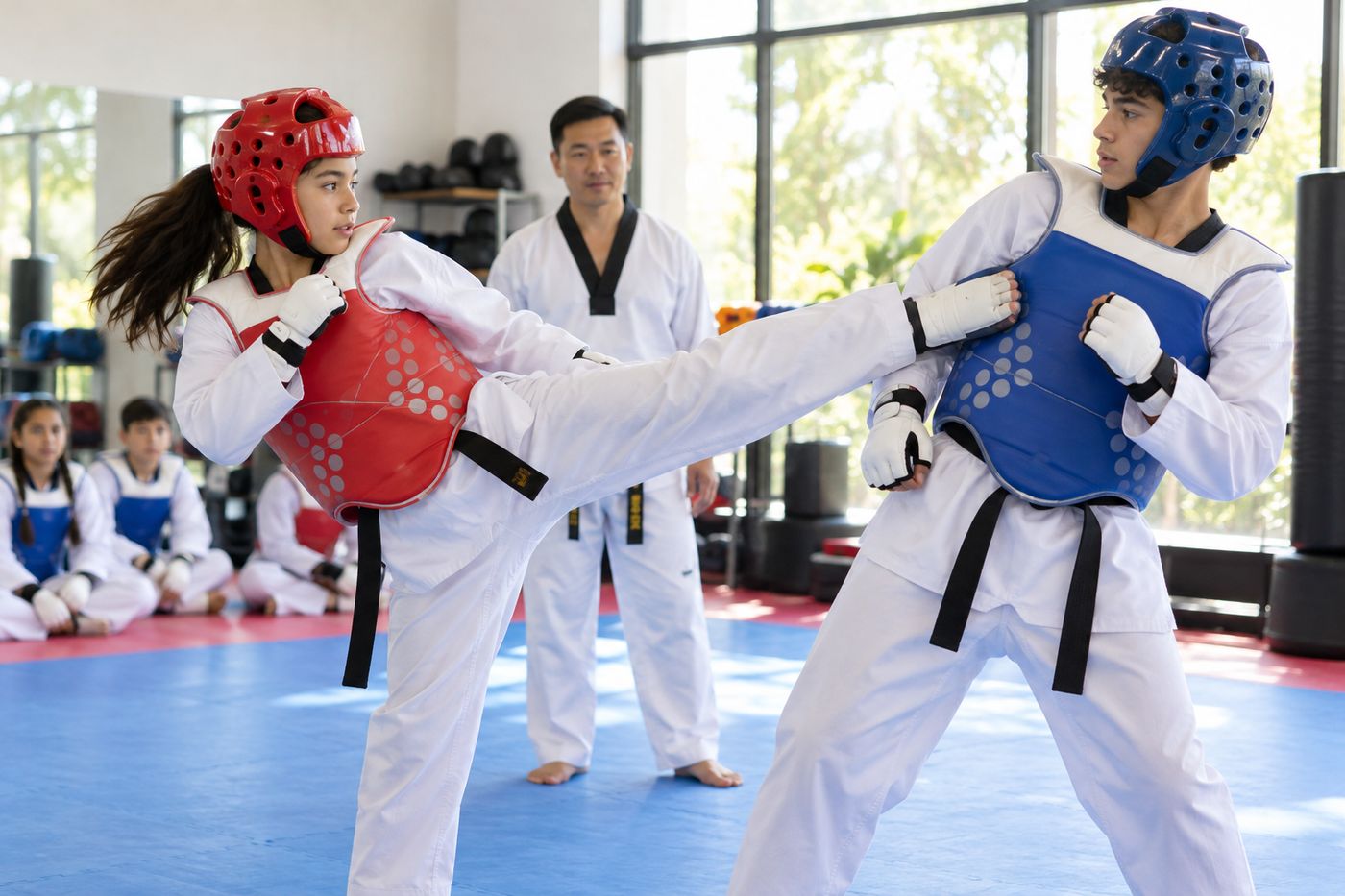
In Olympic-style sparring, the hook kick is used to reach the head of an opponent who has their guard set for a roundhouse. It scores as a head kick. It is also used to strike around an opponent’s raised arm. Outside sparring, it appears less often, but learning it builds the hip control needed for the spinning hook kick.
How to do a hook kick, step by step
- Start in a fighting stance, side-on, guard up.
- Lift the kicking knee up and across the body, as if starting a side kick, with the foot pointing just past the target.
- Pivot the standing foot so the heel turns toward the target, and turn the hip over.
- Extend the leg out slightly to the side of the target, aiming a little past it.
- Whip the lower leg back toward you from the knee, striking with the heel or the sole of the foot.
- Bring the knee back to the chamber and set the foot down in your stance.
Think of the kick as a side kick that misses on purpose and then hooks back. The whip at the end should come from the hip and hamstring, not just the knee.
Common mistakes
Swinging the whole leg in a big circle is the most common error. It is slow and easy to read. Extend the leg first, then whip back in a short, sharp motion.
The second is locking the knee straight at the end of the extension and then forcing the whip. That strains the knee. Keep a small bend. Third, students often do not turn the hip over enough, so the kick becomes a weak, upward flick. Pivot the standing foot fully. Last, many students lose their guard as they kick. Keep the hands up, especially the rear hand, which protects the face as you lean back.
Drills to practise at home
Slow hooks along a wall. Stand side-on to a wall about a leg’s length away, extend the leg along the wall past an imaginary target, then hook back slowly. The wall keeps the path tidy.
Chamber-extend-hook. Break the kick into three counts, holding each position for a second. This builds the hip strength that keeps the kick high.
Target practice. Hang a towel at chest or head height and practise hooking it with the heel, starting slowly.
Stretching. Hook kicks need flexible hamstrings and hips. See our guide to kicking higher.
Where it fits in your training
The hook kick is usually taught around purple belt, after the side kick is solid. It leads directly to the spinning hook kick. For every other kick and when it is usually taught, see our guide to Taekwondo kicks.
Questions parents and students ask
What is the difference between a hook kick and a roundhouse kick?
They travel in opposite directions. A roundhouse swings in toward the target from the outside and hits with the top of the foot. A hook kick extends past the target and then whips back toward you, hitting with the heel or sole.
Does a hook kick score in Taekwondo sparring?
Yes. A hook kick that lands on the headgear scores as a head kick. Because it comes from an unusual angle, it often catches opponents who are guarding against a roundhouse.
Is the hook kick hard on the knee?
It can be if the knee is snapped straight with force. Keep a slight bend at full extension and whip from the hip rather than locking the knee.