On this page
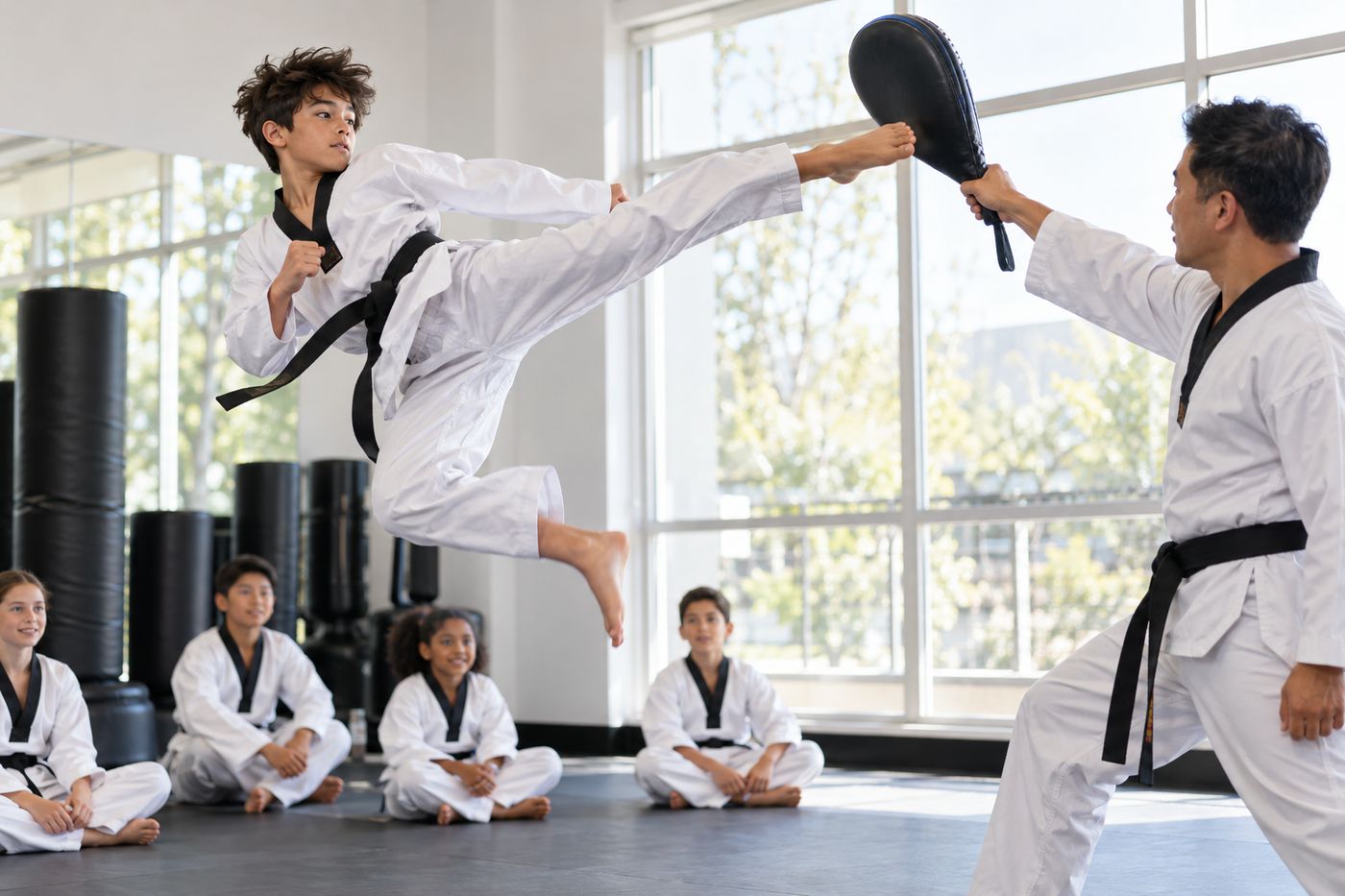
The jumping side kick, ttwieo yeop chagi (뛰어옆차기), is the side kick taken into the air. From a standing jump it is a powerful, compact kick for boards held at chest or head height. With a run-up, it becomes the famous flying side kick, the kick in the classic demonstration photo where a student sails over a line of people to break a board. It needs a strong standing side kick first, and good landings matter as much as the kick itself.
What the jumping side kick is used for
The jumping side kick is mainly a breaking and demonstration kick. It drives the heel into a board with the weight of the whole body moving forward. In sparring it is uncommon in modern Olympic rules, although a jumping side kick can be used to close distance or stop an opponent who is rushing in.
How to do a jumping side kick, step by step
- Start in a fighting stance, side-on to the target.
- Take a short step or skip forward to build momentum. For a flying side kick, take a run-up of a few steps.
- Drive the back knee up and jump off the front foot.
- In the air, bring the kicking knee up into a tight side kick chamber, heel pointed at the target, and turn the hip over.
- Drive the heel out to the target in a straight line, at the top of the jump.
- Pull the leg back and land on the non-kicking foot, then the kicking foot, bending the knees to absorb the landing.
At full extension, the head, hip and heel should form a line, just like a standing side kick.
Common mistakes
Kicking with the hip unturned is the most common error, the same as with the standing side kick. The toes should point forward or slightly down, not up.
The second is extending the kick too early or too late. The kick should land at the top of the jump. Practise the timing at a low height first. Third, students often throw the body forward and lose the chamber, kicking with a straight leg that swings up. Keep the knee tight before you extend. Last, landing with stiff legs or on the kicking leg first is a common cause of ankle and knee injuries. Land on the back foot and bend.
Drills to practise at home
Standing side kick first. A strong, accurate side kick from the floor is the foundation. See our side kick guide.
Skip side kicks. Skip forward and throw a side kick at the top of the skip, staying low. This teaches the timing without much height.
Chamber holds. Hold the side kick chamber for five seconds on each leg to build the strength to hold it in the air.
Landing drills. Practise small jumps that land softly on one foot then the other. Good landings protect knees and ankles.
Full flying side kicks are best practised on a mat with an instructor, not in a living room.
Where it fits in your training
The jumping side kick usually comes around brown belt or later, after the standing side kick is solid. For the other jumping kicks, see the jumping front kick and jumping back kick, and for every kick, the kicks guide.
Questions parents and students ask
What is the difference between a jumping side kick and a flying side kick?
A jumping side kick is usually thrown from a standing start or one step. A flying side kick uses a run-up of several steps for distance and height. Both finish with a side kick in the air.
Is the jumping side kick used in breaking?
Yes. It is one of the classic breaking kicks, especially the flying version, which can go over obstacles or people held in a line during demonstrations.
What belt learns the jumping side kick?
Usually around brown or red belt, once the standing side kick is strong and on target.