On this page
The roundhouse kick, dollyeo chagi (돌려차기), is the most used kick in Taekwondo. Watch any Olympic match and most of the points come from it, and watch any belt test and you will see it on the pads from yellow belt up. It is fast, it can hit the body or the head, and it can be thrown from almost any position. It is also a kick that many students do slightly wrong for years, usually because the standing foot does not pivot.
What the roundhouse kick is used for
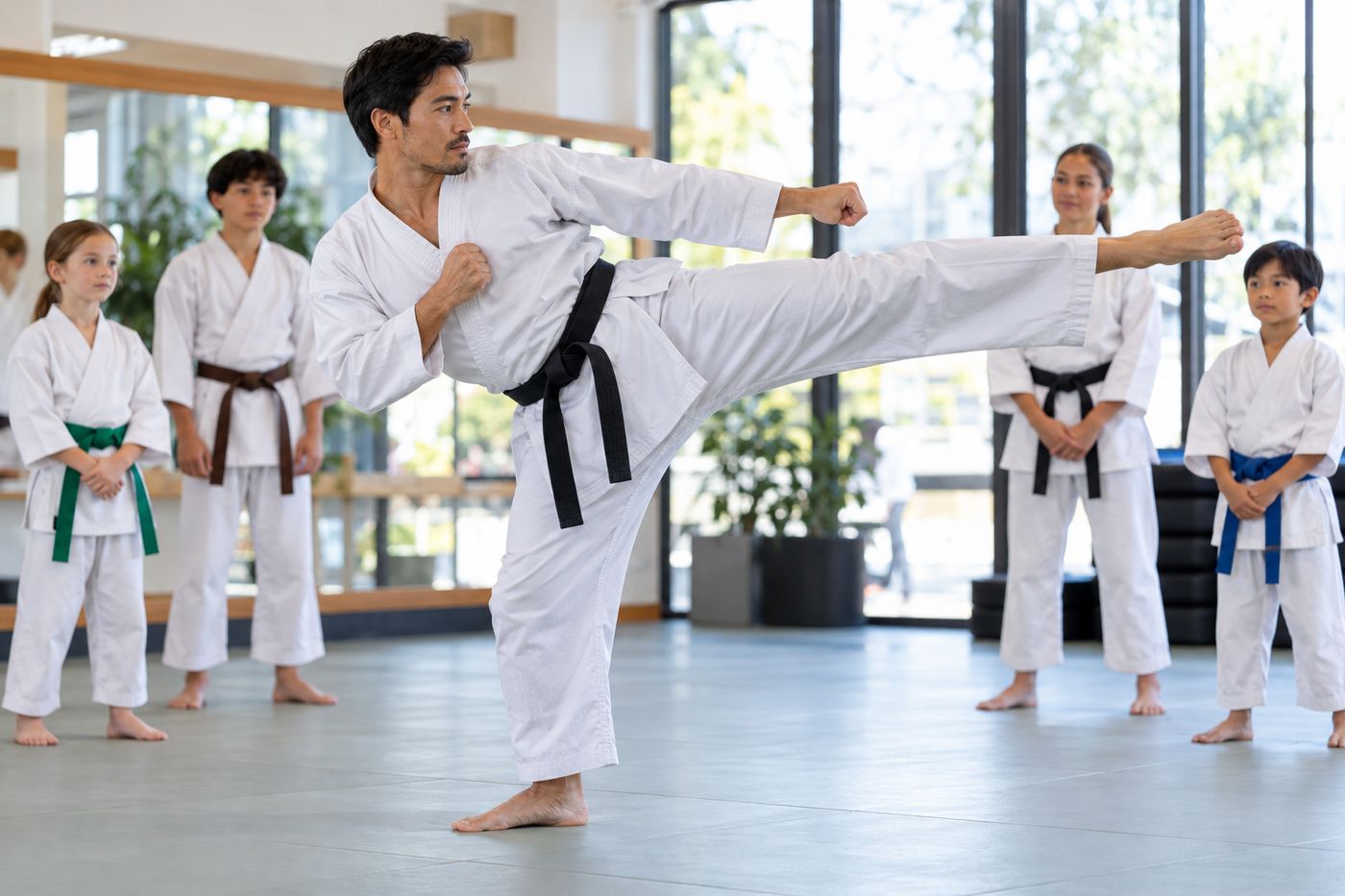
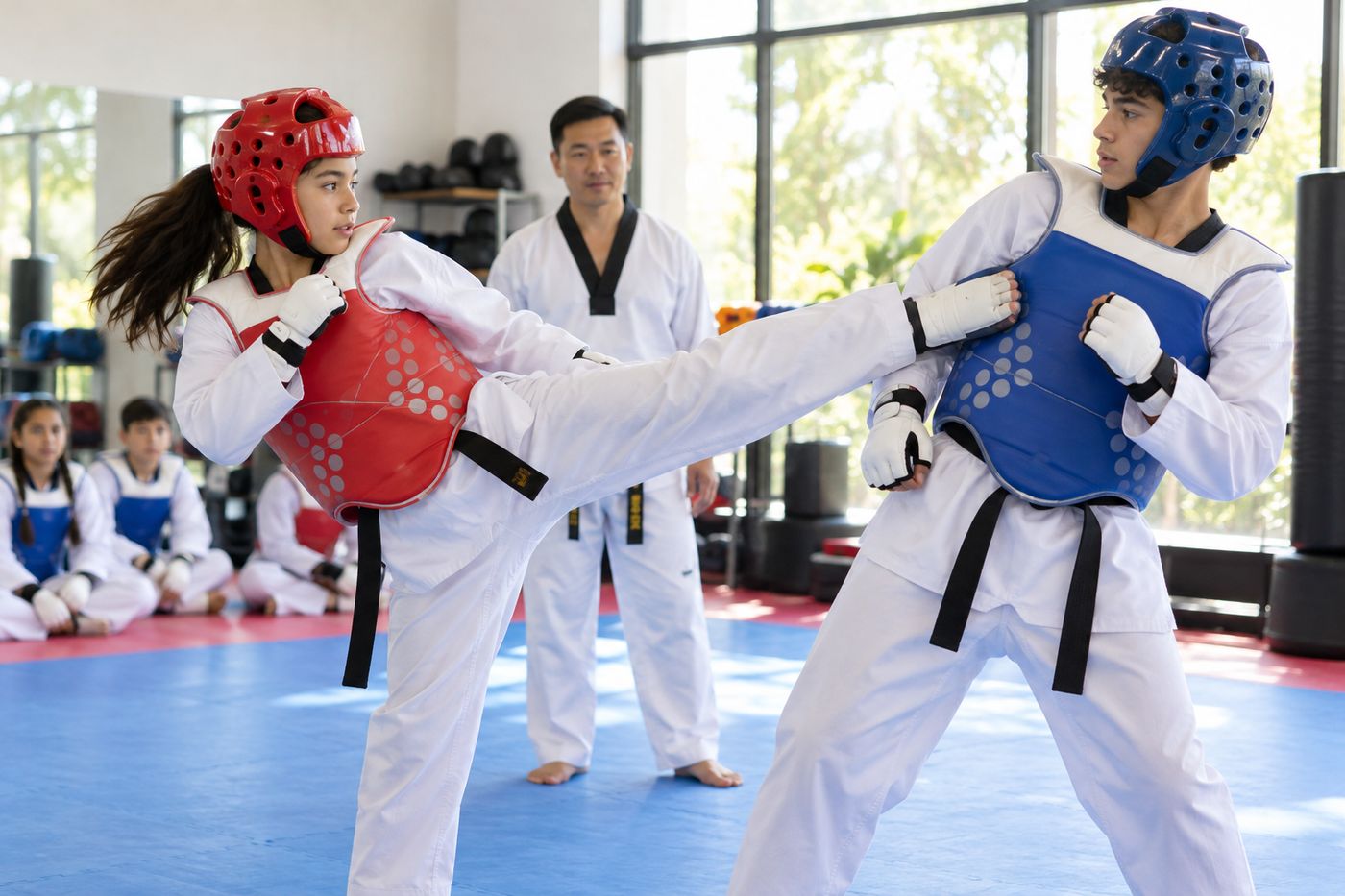
The roundhouse travels in an arc from the side, striking the target with the top of the foot. In sparring it is the main scoring kick to the chest protector, worth two points to the body and three to the head under World Taekwondo rules. In self-defense it targets the ribs, thigh or head. In the forms, it first appears in Taegeuk Yuk Jang.
How to do a roundhouse kick, step by step
- Start in a fighting stance, side-on to the target, with your guard up.
- Lift the back knee up and forward, pointing it at the target. At this moment the kick looks just like a front kick, which helps hide it.
- As the knee rises, pivot on the ball of the standing foot so the heel turns toward the target. Turn the hip over so the kicking leg is parallel to the floor, or angled up for a head kick.
- Snap the lower leg out from the knee and strike with the top of the foot, toes pointed.
- Snap the lower leg back to the chamber, then set the foot down in front, back in your stance, or into the next technique.
The kick is a single smooth motion. The lift, the pivot and the hip turn all happen together rather than one after the other.
Common mistakes
Not pivoting the standing foot is by far the most common error. If the standing foot stays pointing forward, the hip cannot turn over, the kick loses power and the knee twists under load. Make the pivot part of the kick from the start.
Swinging the leg in a wide circle is the second. A big swing looks powerful but is slow and easy to see. Keep the knee pointed at the target until the last moment. The third is leaning far back to get height. A little lean is natural, but if the upper body falls away the kick has no weight behind it and you will lose balance on the landing. Finally, watch the hands: the arm on the kicking side often swings down to counterbalance. Keep at least the front hand up to guard the face.
Drills to practise at home
Pivot drill. Without kicking, lift the knee and pivot the standing foot together, ten times on each side. It builds the habit that matters most.
Chair-supported kicks. Hold the back of a chair for balance and kick slowly to the side at waist height, holding the extended position for two seconds before returning. This builds hip strength and shows whether the hip is turning over.
Fast kicks on a pillow. Have someone hold a pillow at stomach height and throw ten quick roundhouses in a row without putting the foot down. Speed matters more than power here.
Switch-kick combinations. Practise a roundhouse with the back leg, set it down in front, then kick with the other leg. This is the basic rhythm of Taekwondo sparring.
Where it fits in your training
The roundhouse kick is usually introduced at yellow belt and drilled on pads at every belt after. It is the base for the double kick, the tornado kick and the 540 kick. For how it scores in a match, see our guide to sparring rules and gear, and for every other kick, the kicks guide.
Questions parents and students ask
Which part of the foot hits in a roundhouse kick?
In Olympic-style Taekwondo and sparring, the top of the foot (baldeung), which also triggers the sensors in electronic scoring socks. In breaking and some traditional schools, the ball of the foot is used for more penetration.
How do I make my roundhouse kick faster?
Keep the chamber tight and the kick short: lift the knee straight up toward the target, turn the hip over and snap. Wide, swinging kicks are slow. Pivoting the standing foot early also lets the hip turn freely.
How far should the standing foot turn?
For a body kick, roughly 90 to 180 degrees, so the heel points toward the target or close to it. Not turning the standing foot is the most common reason for knee strain and a weak kick.